by Chelsea Nadine Brazal
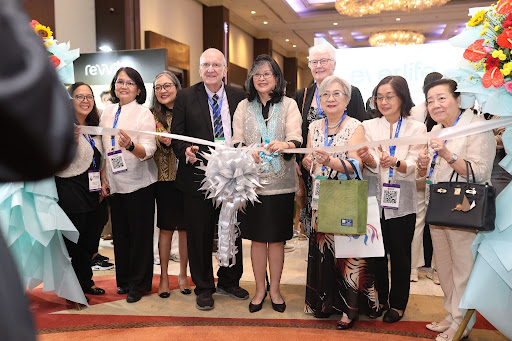
Thirty years ago, newborn screening in the Philippines began with 24 hospitals, a small group of committed health workers, and no local laboratory.
For the program’s first 15 months, blood samples were consolidated at the University of the Philippines (UP) Manila and shipped daily to the New South Wales Newborn Screening Laboratory in Australia. Results were returned by fax or telephone.
Today, newborn screening reaches more than 7,000 facilities across the country. In 2025 alone, around 1.3 million babies were screened, bringing national coverage to 96.8
percent—surpassing the 95 percent target set for 2030.
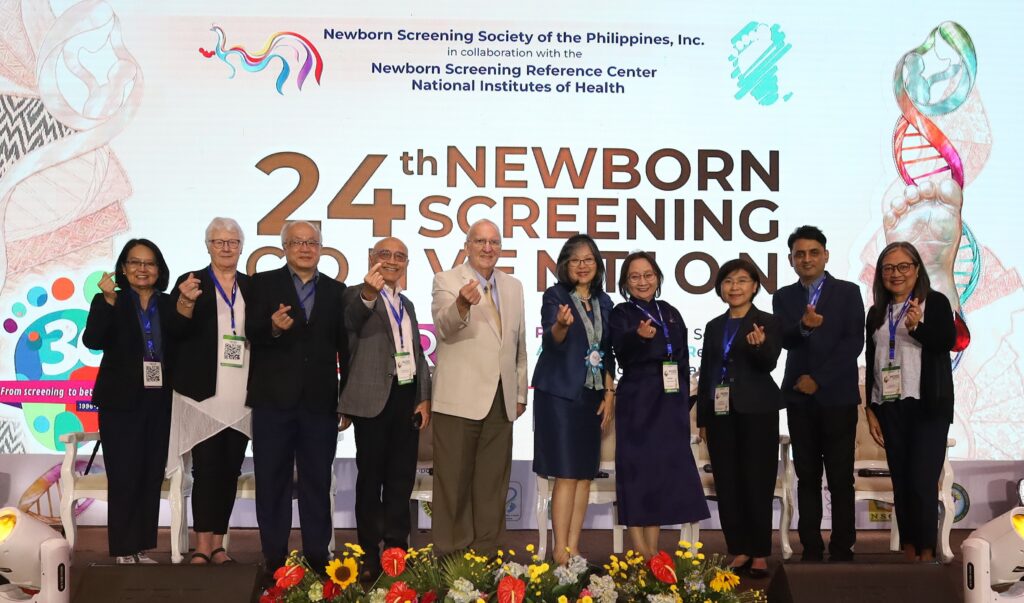
These milestones are captured in the theme of the 24th National Newborn Screening Convention PEARLS—Progress, Expanded Services, Accomplishments, Research, Legacy, and Surveillance, held on October 5-6, 2026 at the Manila Hotel. Together, the six words
reflect not only how far newborn screening has come, but also the work that continues to shape its future.
For Dr. Carmencita Padilla, National Scientist and one of tthe program’s proponents, the
transformation is remarkable precisely because of how little they had at the beginning.
“We started with nothing,” she recalled during the convention, describing the passion of the pediatricians and health workers who helped build the program from the ground up.
The early work was supported by research grants from UP Manila and the Department of Science and Technology – Philippine Council for Health Research and Development, which helped provide the resources needed to develop and establish the program locally.
FROM A SMALL BEGINNING TO NATIONAL PROGRESS
The first major milestone came in September 1997, when the Philippines opened its first newborn screening laboratory at the National Institutes of Health (NIH) in UP Manila. With the help of Dr. Veronica Catherine Wiley of the New South Wales Newborn Screening Laboratory, the Philippine laboratory was computerized from day one.
By 1999, 30 DOH regional coordinators had undergone newborn screening training. DOH
Administrative Order No. 1-A, issued in 2000, further mobilized regional offices and hospitals, helping participation grow from 69 hospitals in 1999 to 284 by 2003.
International mentors and partners, including Dr. Bradford Therrell, Jr., the International Atomic Energy Agency (IAEA), and Wallac Oy, provided valuable technical and program support, while local institutions such as the Philippine Pediatric Society, the Philippine Obstetrical and Gynecological Society, the National Academy of Science and Technology Philippines, and private-sector partners helped give the fledgling program credibility, resources, and momentum.
Then came a defining milestone: Republic Act 9288, or the Newborn Screening Act of 2004, institutionalized the National Newborn Screening System.
EXPANDED SERVICES, EXPANDED POSSIBILITIES
The original program screened for five conditions. Today, Expanded Newborn Screening covers 29 disorders. PhilHealth has also incorporated screening into its Newborn Care Package, helping make screening more accessible to families.

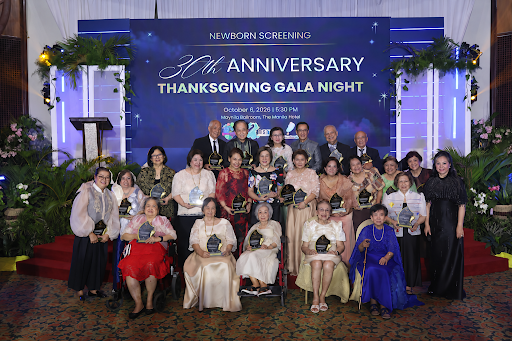
In her message during the 30th anniversary thanksgiving Gala Night on October 6, 2026, PhilHealth Acting President and CEO Dr. Beverly Lorraine C. Ho highlighted how the agency’s support has evolved alongside the program. Since 2006, PhilHealth has been providing benefit coverage for newborn screening. But for Ho, the work cannot end with
screening. “The next step is ensuring that children are screened early and connected to the care they need,” she said.
Today, newborn screening has grown beyond the initial test itself. Dr. Leilanie Apostol-Nicodemus, Director of the Newborn Screening Reference Center (NSRC), emphasized that the program now encompasses quality assurance, confirmatory testing, follow-up and treatment, data management, research, surveillance, and efforts to ensure access even in underserved communities.
Its development has therefore been about expanding not just the number of conditions detected, but the services and systems needed to act on those results.
RESEARCH, LEGACY, AND THE WORK AHEAD
The program’s evolution has also been driven by research, innovation, and the people who have carried its work across generations.
